Biases in the distribution of primes in intervals
1 TL;DR
The histogram shows the distribution of primes in intervals. Cramér’s random model leads to predictions for this distribution, shown in blue and orange. We have another prediction, shown in green. In the data we’ve looked at, as here, our prediction seems to fare better than the ones based on Cramér’s model.
As suggested in (Freiberg 2018), our prediction is based on the Hardy-Littlewood prime tuples conjecture (Hardy and Littlewood 1923), inclusion-exclusion, and a precise estimate, due to Montgomery and Soundararajan (Montgomery and Soundararajan 2004), for a certain average involving the singular series of the prime tuples conjecture. The prediction is derived in (Freiberg 2026).
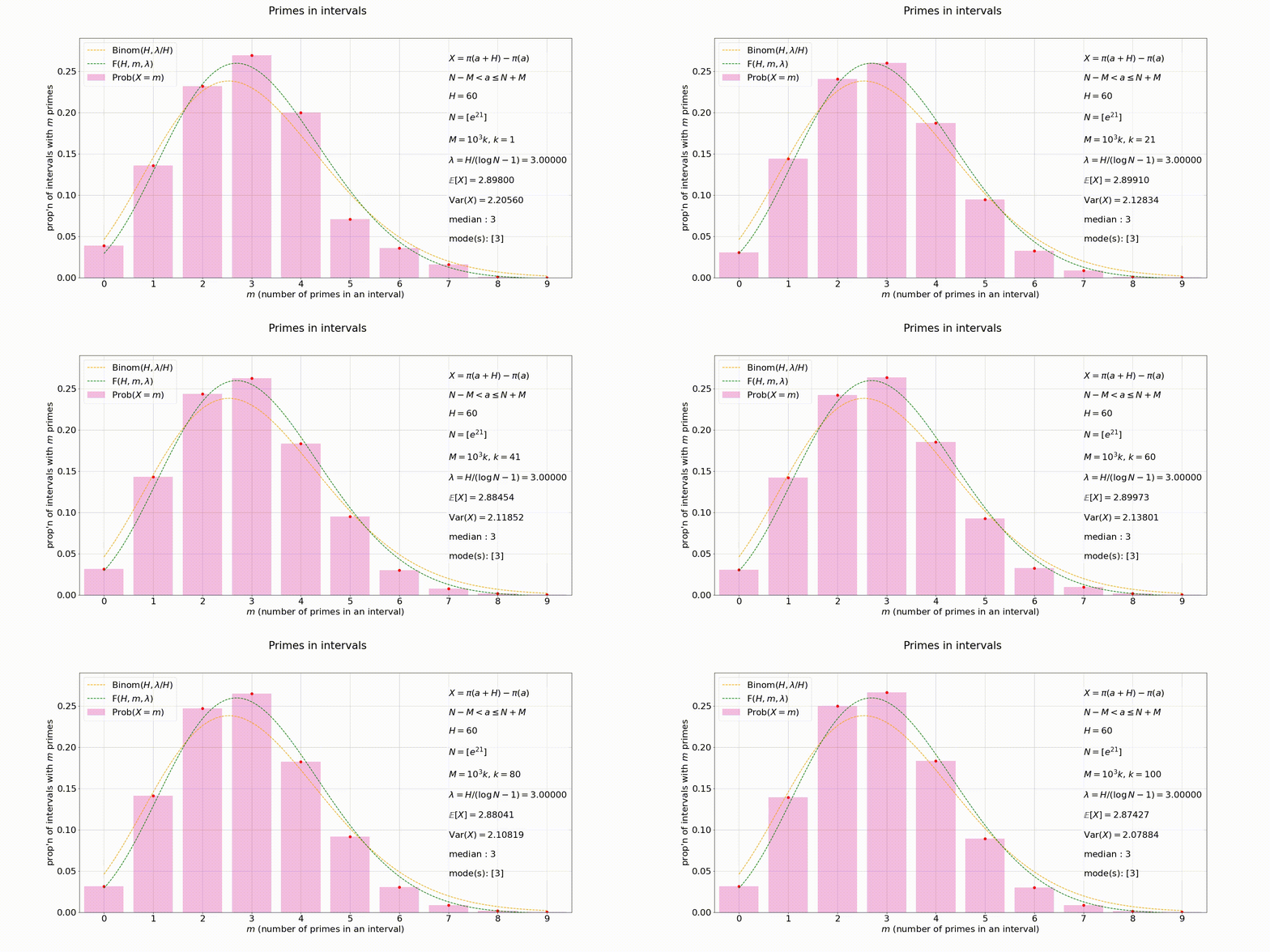
For integers \(H \ge 1\), \(M \ge 0\) and \(N \ge 2\), the histogram shows the proportion
\[P(m; H, M, N) = \frac{1}{N}\#\{M < n \le M + N : \pi(n + H) - \pi(n) = m\}\]
of intervals \((n, n + H]\), with \(M < n \le M + N\), that contain exactly \(m\) primes. In the animation, \(H = 60\) and the range of starting points grows outward from \(x_0 = [e^{21}]\): the text box writes it as \(x_0 - K < a \le x_0 + K\), so that \(M = x_0 - K\) and \(N = 2K\).
In Cramér’s model, an integer \(t\) is “prime” with probability \(1/\log t\). Averaging \(H/\log t\) over the range gives
\[\mu = \frac{H}{N}\int_{\max\{2, M\}}^{M + N}\frac{dt}{\log t},\]
the expected number of “primes” in an interval of length \(H\). Writing \(p_m(u) = e^{-u}u^m/m!\) for the Poisson probability, Cramér’s model leads to the averaged Poisson prediction (blue)
\[F_0(m; H, M, N) = \frac{1}{N}\int_{\max\{2, M\}}^{M + N} p_m\left(\frac{H}{\log t}\right)dt.\]
Treating the probability as constant across the range gives instead the Binomial distribution \(\mathrm{Binom}(H,\mu/H)\) (orange), whose probability mass function satisfies, for fixed \(m\) and \(\mu \asymp 1\),
\[\binom{H}{m}\left(\frac{\mu}{H}\right)^m\left(1 - \frac{\mu}{H}\right)^{H - m} = p_m(\mu)\left\{1 - \frac{C_2(m; \mu)}{2H} + O(H^{-2})\right\}, \qquad C_2(m; u) = (m - u)^2 - m.\]
Our prediction (green) is
\[F(m; H, M, N) = \frac{1}{N}\int_{\max\{2, M\}}^{M + N} Q\left(m; \frac{H}{\log t}, H\right)dt,\]
where
\[Q(m; u, H) = p_m(u)\left\{1 - \frac{\eta(H)}{2}C_2(m; u)\right\}, \qquad \eta(H) = \frac{\log H + \log 2\pi + \gamma - 1}{H},\]
and \(\gamma\) is the Euler-Mascheroni constant. The correction has the same polynomial \(C_2(m; u)\) as the Binomial, but its coefficient is larger by a factor asymptotic to \(\log H\), so our prediction agrees with Cramér’s model only as a first-order approximation. The correction increases the Poisson probability where \((m - u)^2 < m\) and decreases it elsewhere. This is more in line with our observation that the distribution of the numerical data is more “pinched up” around the center: there is more of a bias towards the mean than is suggested by the Binomial distribution. Assuming a uniform version of the Hardy-Littlewood conjecture, one can show (Freiberg 2026) that for fixed \(m\), \(M = 0\), and \(H\) of order \(\log N\),
\[P(m; H, 0, N) = Q(m; \lambda, H) + o\left(\frac{1}{H}\right), \qquad \lambda = \frac{H}{\log N - 1},\]
as \(N \to \infty\). (Note that \(F(m; H, M, N)\) is not a probability mass function: it can be slightly negative in the tails, as in the animation, and its sum over \(m\) is \((M + N - \max\{2, M\})/N\), which equals \(1\) only when \(M \ge 2\). \(F(m; H, M, N)\) is an approximation to a probability mass function, viz. the probability that the interval \((n, n + H]\) of length \(H\), \(n\) chosen uniformly at random from \((M, M + N]\), contains exactly \(m\) primes. Whether one can find modifications to the higher order terms in the expansion of the Binomial probability that lead to even better predictions for the distribution of primes in intervals is a tantalizing question, worth pursuing.)